Lord Caitanya Mahâprabhu experienced divine love, a mysticism of the highest order, and He communicated the confidential essence of this love to His most intimate followers. It was their responsibility to systematize this knowledge and to formulate a method for its wide distribution. After all, how would future generations understand what Mahâprabhu felt? And how would they attempt to recapture the experience? It were the six Gosvâmîs of Vrindâvan who took the challenge to heart, making Mahâprabhu's inner experience accessible.
Raghunath Das Gosvâmî (1495-1571) was the first to meet the Master. He was born in a non-brâhmana family (which made him distinct among the six Gosvâmîs) in the town of Chandpur (now S'rî Krishnapur), West Bengal. He was extremely wealthy, yet he had a distaste for material riches. Due to association with the great saint Haridas Thakur, Raghunath Das anxiously anticipated the day he could see S'rî Caitanya. This occurred shortly after Mahâprabhu took sannyas, in 1510, when the young Raghunath Das ran away from home to meet Mahâprabhu in Shantipur. Das Gosvâmî, as Raghunath Das came to be called, became the preeminent mystic in the Vaishnava tradition and composed beautiful poetry based on his meditation.
In South India, shortly after meeting Ragunath Das Gosvâmî for the first time, Mahâprabhu stayed at the house of Vyenkata Bhatta. At the time Vyenkata had a seven-year-old son named Gopal Bhatta. He would be trained by Mahâprabhu Himself and eventually grow up to be one of the major theologians of Gaudiya Vaishnavism, Gopal Bhatta Gosvâmî (1503-1578).
As a South Indian brâhmana, Gopal Bhatta was keenly aware of the minutiae of day-to-day Vaishnava practice; thus he would be an invaluable asset to the mission of the Gosvâmîs. Along with Sanatan Gosvâmî, he compiled the "lawbook" for Gaudiya Vaishnavas, called the Hari-bhakti-vilas. The book details minute aspects of the tradition, including deity worship, temple rituals, and Vaishnava etiquette.
Rupa (1489-1564) and Sanatan (1488-1558) Gosvâmîs, also of South India roots, worked for the Islamic government in Bengal. Both were great scholars and leaders. S'rî Caitanya's wave of devotion swept them up too, and they were introduced to Mahâprabhu when He was on His way to Vrindâvan. Later, Rupa met the Master in Prayag (now Allahabad) and received instruction in rasa theology from Him. Sanatan met Mahâprabhu in Benares and there learned from Him the science of avatârs and the complex philosophy of how God manifests in this world. Rupa and Sanatan were prolific writers. Their contributions manifested in the form of drama, poetry, and philosophy.
The work of Rupa and Sanatan was expanded by their young nephew, Jiva Gosvâmî (1513-1598), who is to this day considered one of India's greatest philosophers. He developed themes begun by his renowned uncles and highlighted the nuances of their theological ideals. Some say that Jiva, the youngest of the Six, met S'rî Caitanya on only one occasion, as a child. Still, this one meeting, along with the inspiration derived from Rupa and Sanatan, was enough to sustain Jiva throughout his productive career.
Raghunath Bhatta Gosvâmî (1505-1579) offered no literary contribution, but was known for his beautiful singing and for his elaborate recitation of the Bhâgavatam. Indeed, the essence of Vaishnava theology centers on kirtan, the ecstatic singing of the holy name. Raghunath Bhatta Gosvâmî set the highest example by singing the glories of the Lord like no other.
Srînivâsa Âcârya composed 'the eight verses for the six Gosvâmîs', S'rî S'rî Shadgosvâmy-ashthaka (listen online /lyrics) and the lyrics are given below in a translation by Swâmi Prabhupâda:
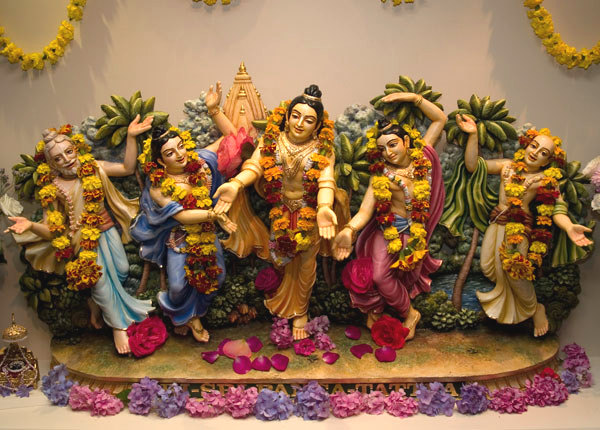
Pañca-tattva: (pañca: five) The reality of Lord Caitanya Mahâprabhu as consisting of Himself, Nityânanda,
Advaita Âcârya, Gadâdhara and S'rî Vasâdi, installed in a temple
1. I offer my respectful obeisances unto the six Gosvâmîs, namely S'rî Rupa Gosvâmî, S'rî Sanatana Gosvâmî, S'rî Raghunatha Bhatta Gosvâmî, S'rî Raghunatha dasa Gosvâmî, Srî Jiva Gosvâmî, and S'rî Gopala Bhatta Gosvâmî, who are always engaged in chanting the holy name of Krishna and dancing. They are just like the ocean of love of God, and they are popular both with the gentle and with the ruffians, because they are not envious of anyone. Whatever they do, they are all-pleasing to everyone, and they are fully blessed by Lord Caitanya. Thus they are engaged in missionary activities meant to deliver all the conditioned souls in the material universe.
2. I offer my respectful obeisances unto the six Gosvâmîs, namely S'rî Rupa Gosvâmî, S'rî Sanatana Gosvâmî, S'rî Raghunatha Bhatta Gosvâmî, S'rî Raghunatha dasa Gosvâmî, S'rî Jiva Gosvâmî, and S'rî Gopala Bhatta Gosvâmî, who are very expert in scrutinizingly studying all the revealed scriptures with the aim of establishing eternal religious principles for the benefit of all human beings. Thus they are honored all over the three worlds and they are worth taking shelter of because they are absorbed in the mood of the gopis and are engaged in the transcendental loving service of Râdhâ and Krishna.
3. I offer my respectful obeisances unto the six Gosvâmîs, namely S'rî Rupa Gosvâmî, S'rî Sanatana Gosvâmî, S'rî Raghunatha Bhatta Gosvâmî, S'rî Raghunatha dasa Gosvâmî, S'rî Jiva Gosvâmî, and S'rî Gopala Bhatta Gosvâmî, who are very much enriched in understanding of Lord Caitanya and who are thus expert in narrating His transcendental qualities. They can purify all conditioned souls from the reactions of their sinful activities by pouring upon them transcendental songs about Govinda. As such, they are very expert in increasing the limits of the ocean of transcendental bliss, and they are the saviors of the living entities from the devouring mouth of liberation.
4. I offer my respectful obeisances unto the six Gosvâmîs, namely S'rî Rupa Gosvâmî, S'rî Sanatana Gosvâmî, S'rî Raghunatha Bhatta Gosvâmî, S'rî Raghunatha dasa Gosvâmî, S'rî Jiva Gosvâmî, and S'rî Gopala Bhatta Gosvâmî, who kicked off all association of aristocracy as insignificant. In order to deliver the poor conditioned souls, they accepted loincloths, treating themselves as mendicants, but they are always merged in the ecstatic ocean of the gopis' love for Krishna and bathe always and repeatedly in the waves of that ocean.
5. I offer my respectful obeisances unto the six Gosvâmîs, namely S'rî Rupa Gosvâmî, S'rî Sanatana Gosvâmî, S'rî Raghunatha Bhatta Gosvâmî, S'rî Raghunatha dasa Gosvâmî, S'rî Jiva Gosvâmî, and S'rî Gopala Bhatta Gosvâmî, who were always engaged in worshiping Râdhâ-Krishna in the transcendental land of Vrindavana where there are beautiful trees full of fruits and flowers which have under their roots all valuable jewels. The Gosvâmîs are perfectly competent to bestow upon the living entities the greatest boon of the goal of life.
6. I offer my respectful obeisances unto the six Gosvâmîs, namely S'rî Rupa Gosvâmî, S'rî Sanatana Gosvâmî, S'rî Raghunatha Bhatta Gosvâmî, S'rî Raghunatha dasa Gosvâmî, S'rî Jiva Gosvâmî, and S'rî Gopala Bhatta Gosvâmî, who were engaged in chanting the holy names of the Lord and bowing down in a scheduled measurement. In this way they utilized their valuable lives and in executing these devotional activities they conquered over eating and sleeping and were always meek and humble enchanted by remembering the transcendental qualities of the Lord.
7. I offer my respectful obeisances unto the six Gosvâmîs, namely S'rî Rupa Gosvâmî, S'rî Sanatana Gosvâmî, S'rî Raghunatha Bhatta Gosvâmî, S'rî Raghunatha dasa Gosvâmî, S'rî Jiva Gosvâmî, and S'rî Gopala Bhatta Gosvâmî, who were sometimes on the bank of the Râdhâ-kunda lake or the shores of the Yamuna and sometimes at Varnsivata. There they appeared just like madmen in the full ecstasy of love for Krishna, exhibiting different transcendental symptoms in their bodies, and they were merged in the ecstasy of Krishna consciousness.
8. I offer my respectful obeisances unto the six Gosvâmîs, namely S'rî Rupa Gosvâmî, S'rî Sanatana Gosvâmî, S'rî Raghunatha Bhatta Gosvâmî, S'rî Raghunatha dasa Gosvâmî, S'rî Jiva Gosvâmî, and S'rî Gopala Bhatta Gosvâmî, who were chanting very loudly everywhere in Vrindavana, shouting, "Queen of Vrindavana, Râdhârânî! O Lalita! O son of Nanda Maharaja! Where are you all now? Are you just on the hill of Govardhana, or are you under the trees on the bank of the Yamuna? Where are you?" These were their moods in executing Krishna consciousness.

Comments