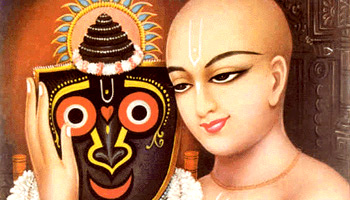
The essence of S'rî Caitanya's teaching is bhakti, or devotional love for Krishna. In the second verse of his famed sutras on bhakti, Shandilya defines bhakti as "exclusive and intense loving attachment to the Lord." The Vaishnava sage Nârada elaborates upon this definition in his Nârada-bhakti-sutra, where He says, "Bhakti consists of offering one's every action to the Supreme Lord and feeling extreme distress in forgetting Him." [Chapter 2, sutra 19]
The very first book [Canto 1] of S'rîmad Bhâgavatam defines bhakti as parama-dharma, or "the highest and most satisfying function of the soul." Bhakti is thus paramount in Vaishnava thought.
The concept of bhakti is found in the writings of the South Indian Alvars [Alvar means one who is "immersed" in the experience of God, the omnipresent mysterious One], who belonged to India's earliest organized Vaishnava tradision, Srivaishnavism. It is also found in the North, as is amply represented by the works of Rupa Gosvami, whose bhakti-rasa theory is at the very core of Gaudiya Vaishnavism. Bhakti became prominent in 15th- and 16th-century India, which witnessed a "bhakti renaissance."
Coincidentally, during this same period the Western world experienced its own renaissance - one that moved in the opposite direction. If the Indian renaissance emphasized devotion to God, the Western one focused on empirical learning and material progress, on science and technology. In essence, Western materialism came to the fore, and spirituality receded to the background.
The European Renaissance is often remembered as a period of growth, a journey toward self-sufficiency and self-discovery. To characterize these times, historian Jules Michelet coined the term "rebirth". Those were times of a newfound awakening of man, when he was able to escape his preoccupation with religion and superstition and to become truly progressive by focusing on material nature, on the body, and on the world around him. Man moved toward materialistic complexity, leaving spirituality and simple living as a thing of the past.
Most of India has been greatly influenced by bhakti and bhakti's practitioners. This may be because bhakti addresses something fundamental in man, and because the opposite - a renaissance moving toward material progress - while advantageous in some ways, ultimately leaves one spiritually barren, in being without a soul.


Comments