Listen to:
S'rî S'achî-Sutâshthakam:
Eight prayers glorifying the Son of S'rîmatî S'achi Devî
and read the lyrics
Navadvîp is a large trading center of regional importance to the handloom cloth industry. It is situated about 65 miles north of Kolkata (Calcutta), connected to it by road, river, and rail. More importantly, Navadvîp is famous as the birthplace of S'rî Caitanya, who is also known as Gaur and Gauranga, the "golden" incarnation.
S'rî Caitanya is nondifferent from S'rî Krishna, hence Navadvîp (Mayapur) and the lîlâ of Gaura (Caitanya) and that of Krishna are mystically connected. Vaishnavas reverently refer to the thirty-two-mile Navadvîp/Mayapur region as Gaura-mandala.
In 1063 c.e., Navadvîp became the capital of Bengal under the Hindu rule of Lakshmanasena, but in 1202 it was conquered and destroyed by Muhammed Bakhtiar Khilji. Bengal then passed under Islamic rule. Despite social friction, Hindus and Muslims lived there together. Navadvîp, which was a famous seat of Sanskrit learning, became a stronghold of orthodox brahmanism. It was into this environment that S'rî Caitanya appeared.
Literally hundreds of sites connected to S'rî Caitanya Mahâprabhu's pastimes are found throughout the area. The Yoga-pitha, where Mahâprabhu was born, today houses deities of Him and His associates. The spot where He was born is daily visited by pilgrims. Nearby is Shrivas Angan, the house of Shrivas Thakur, where S'rî Caitanya inaugurated the Sankîrtan movement.
Historically, Navadvîp is considered to have been an area consisting of nine islands. Thus it derives its name: nava (nine), dvîpa (islands). Many believe "the nine islands" refer to nine spiritual islands to be perceived only by those who have attained the topmost realization: because nine islands, as such, are nowhere to be found. Pilgrims generally tour the area of "nine islands" in the following sequence: Antardvip, Simantadvip, Godrumdvip, Madhyadvip, Koladvip, Ritudvip, Jahnudvip, Modadrumadvip and Rudradvip.
In an esoteric sense, the islands correspond to the nine processes of devotional service (bhâgavata dharma): hearing about God, chanting of Him, remembering Him, serving His lotus feet, worshiping Him, praying to Him, assisting Him, befriending Him, and sacrificing everything for Him.
The Rediscovery of S'ri Caitanya's Birthplace.
By the 19th century, few were aware of the importance of Lord Caitanya's life and mission; Muslim conquerors and the passage of time had all but obliterated S'rî Caitanya from history. This was soon to be corrected by a single individual named Bhaktivinode Thhâkur (1838-1914). An avid follower of Caitanya's teachings, Bhaktivinode set out to rediscover the Lord's birthplace.
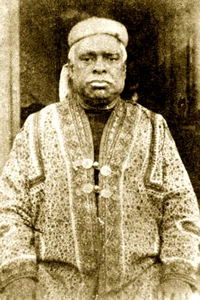 To Bhaktivinode's surprise, the village that his contemporaries knew to be Navadvîp was only one hundred years old and could not possibly be the same Navadvîp in which S'rî Caitanya had appeared. There were diverse opinions, and some said that the Lord's birthplace was now under the Ganges, which had changed its course since the 15th century.
But Bhaktivinode was relentless, and he soon heard of a place northeast of the town then considered Navadvîp. The mysterious old village in question was governed by Muslims. Bhaktivinode soon realized that this was the actual Navadvîp (Mayapur) and sought to confirm this theory with available evidence. Strong proof came from two maps made by British pilots who had navigated the Ganges.
Bhaktivinode found important leads also in regional scriptures. For example, in Narahari Chakravarti's Bhaktiratnakara he read that the courtyard of Shrivas Pandit, where S'rî Caitanya inaugurated the congregational chanting of the Mahâmantra, [listen online / lyrics] was situated one hundred dhanus (200 yards) to the north of the "House of God". The courtyard of Shrivas still exists, as it did in S'rî Caitanya's time (and in Bhaktivinode's as well); it was thus relatively easy to determine the site of S'rî Caitanya's birth. Furthermore, according to the Caitanya-bhagavata, the Muslim governor of Navadvîp was offended because he was able to hear the chanting from Shriva's house while sitting in his own home; it is said that because of this he ordered his men to break the musical instruments of the "Hindu Heathens". This information aided Bhaktivinode in his discovery of S'rî Caitanya's birth site. The evidence was tallied, and it was augmented by further geographical and archeological studies made by Bhaktivinode himself.
In an attempt to get spiritual confirmation of the site's authenticity, Bhaktivinode brought to the area his old and ailing teacher, Jagannath das Babaji. Babaji Maharaj, although incapacitated, began to jump in ecstacy and cry profusely in love of God. Such an outpouring of devine love convinced Bhaktivinode, perhaps more than the hard, external evidence, that this was indeed S'rî Caitanya's birthplace. [Krishna Bhajan composed by Bhaktivinode Thakur, listen online to: S'uddha Bhakata / lyrics ]

Comments